Sunday, March 27, 2011

Robot Snake

Uncle Sam Snakebot
We're betting some of our readers will spend the long weekend communing with nature, where they'll hopefully encounter sunshine, blue skies, and the fresh smell of pine trees--and robotic snakes climbing up trees.
Actually, the last sight is fairly unlikely, unless they're hanging out near Pittsburgh's Carnegie Mellon University. The reptile-inspired Snakebot out of the school's Biorobotics Lab can make its way up a tree impressively, as the new CMU video below demonstrates.
We've previously watched the Snakebot wrapping itself around poles and climbing vertically inside pipes. For its latest trick, a red, white (more silver, really), and blue Snakebot named "Uncle Sam" slithers out of the lab with its biologically inspired gait, wiggles up a tree, and looks around with its camera-enabled head in a strangely lifelike way. It does not, however, sing the "Star-Spangled Banner."
CMU Snakebots such as Uncle Sam have already been used in disaster training exercises around the world and one day could be employed in search and rescue operations to thread through tight spaces that humans and conventional wheeled and legged robots may not be able to reach. The modular robots are built from repeated segments of sensors and actuators, meaning their length can be easily adjusted and they could possibly self-assemble in the field.

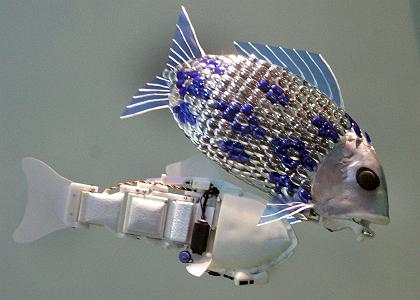
The robot fish

A number of robotic fish are going to be used in an experiment in the port of Gijon in Spain in order to evaluate how effectively and cost-efficiently they can detect water pollution. The 1.5 meter carp-shaped robots are part of a three-year research project of Huosheng Hu and his robotics team at the School of Computer Science and Electronic Engineering, University of Essex. If the research proves itself, the robot fish could be used in rivers, lakes and seas across the world.
The life-like creatures, which will mimic the undulating movement of real fish, will be equipped with tiny chemical sensors to find the source of potentially hazardous pollutants in the water, such as leaks from vessels in the port or underwater pipelines. When they recharge their batteries via a “charging hub” they will be able to transmit the information to the port’s control center. This will enable the authorities to map the source and scale of the pollution virtually in real time.
The robot fish have autonomous navigation capabilities, enabling them to swim independently around the port without any human interaction. This enables them to return automatically to their hub to be recharged when battery life (approximately eight hours) is low.
“I am incredibly excited about this project. We are designing these fish very carefully to ensure that they will be able to detect changes in environmental conditions in the port and pick up on early signs of pollution spreading, for example by locating a small leak in a vessel.”, Hu said, “The hope is that this will prevent potentially hazardous discharges at sea, as the leak would undoubtedly get worse over time if not located.”

Sony's Robot Dog

Sony Robot Dog
Is robo-dog the pet of the future? Sony believes the robot industry can overtake the games market
A metal hound went on show in Tokyo on Tuesday that can bark but not hear. It can cock its leg but will not leave a mess on the carpet. It can even sulk but will never die - at least, not until its batteries run down.
The new toy was unveiled by Sony. Aibo, as it is called, is one of the most advanced "toy" robots yet developed commercially. The company hopes to drive an emerging market in cyber-pets following the worldwide success of Tamagotchi.
Aibo was put through its paces in a demonstration which began when it stood up after being patted on the head. It then waved hello with its front paw. Its best trick was catching a pink ball, which it saw using the color camera installed in its nose.
Robot domination
"The last 10 years of the 20th Century were dominated by personal computers and the Internet," said Sony vice president Toshitada Doi.


Robot Dog


"For the next 10 years, until 2010, we are certain that robots with independent movement will be the big thing."
The gleaming metallic puppy has 18 joints producing 250 types of movement. It can play ball, crouch as if urinating and move its head, body and all its legs.
Aibo's owner can praise his dog by touching its head for more than two seconds. A sharp slap on the head is interpreted as punishment and puts the robot into a sulk.
At the moment, most of the commands are delivered via a remote control, but voice control is being worked on. Aibo, which means partner in Japanese, can make plenty of noise itself, barking, talking and even singing in English or Japanese.


Sony Robotic Dog


The dog is loaded with sensors including the color camera, heat sensors, an infra-red range finder, touch sensors, acceleration and speed sensors and a stereo microphone.
A death function was debated by Sony but not included. Aibo can be revived at any time.
They will be on sale on the Internet from 1 June. Sony said it hoped to sell 3,000 in Japan and 2,000 in the United States.
Sony said it recognized that Aibo would never be a substitute for real dogs. "It is technically impossible to replace real animals with robots. In a sense, it would be a profanity to God," said general manager Tadashi Otsuki.

Brain-controlled robot arm

As we've seen, the FDA approval process for medical devices and other gadgets can be a long one, but it looks like things could soon be speeding up considerably. The agency has just announced a new "Innovation Pathway" program that promises to allow for priority reviews of "truly pioneering technologies," which could potentially cut the approval process time in half. Somewhat ironically, however, that program itself will first need some further review before it's broadly deployed, but the FDA has already kicked things off on a limited basis with its first submission: a brain-controlled robotic arm from DARPA. It's not clear which arm that is, but it sounds a lot like the now-famous "Luke" arm developed by Dean Kamen's Deka organization, which just so happens to be funded by DARPA. Head on past the break for the official press release, and a video of the FDA's webcast announcing the program.
 Update: A tipster has pointed out that the robotic arm in question, and seen briefly in the video after the break, is actually the Modular Prosthetic Limb developed by Johns Hopkins University's Applied Physics Laboratory (now pictured above), not Deka's Luke arm.

The basic humanoid


The basic humanoid frame and head are the same as my previous KHR-1HV buildup. The software and electronics have been completely changed since then.
The many electronics have been replaced with a Roboard. Veltrobot's original software is written using ROS and the IO library provided by Roboard.
The previous setup had too many limitations, for example:


  • Poor video quality.
  • Complilcated communication and process distribution.
  • Insufficient [especially programmable] control of robot body.
Now:
  • The video capture can be done on the robot.
  • There's only one component, no more complex communication schemes between limited microcontrollers. Off robot processing or control can be dispatched with 802.11 or USB Bluetooth.
  • Complete programmable control over the servos is available.
The current goals of this project are to achieve hand-eye coordination, and localization/navigation. These are key basics for a personal robot.
Ultimately, I would like Veltrobot to become a ready-to-go open development kit with features comparable to the Nao. But with free software (as in free as a bird) and hardware for a fraction of the cost.

Inspiring Robots

Robot Athlete Cup  7 tonemapped


I'm not sure exactly why, but Dr. GIY's humanoid cat robot, based on the Kyosho MANOI AT-01 robot design, always makes me chuckle and gets my spirits up, especially when we are facing major challenges like the past week.

Modern Day Geppettos


Robot Athlete Cup  18 tonemapped


Taylor Veltrop demonstrating his master/slave robot control
Today's humanoid robot builders are like modern day Geppettos creating their Pinocchios in their own image, delighted when it can move, walk, manipulate, and mimic their actions.
Where will it all lead? Will the puppet come alive? And, who is the puppet master controlling Geppetto? That's the big adventure and the discoveries yet to come.

Robot Exhibition in Nagoya


Robot Athlete Cup  29 tonemapped

Robot Exhibition in Nagoya
The Nagoya Tokyu Hands store, next to the JR Nagoya station, is hosting an extended robot exhibition from April 4th through April 17th. The exhibition will include robot dance performances, robot soccer, humanoid battles, and flying robot drones.
The event is open to the general public and admission is free. There will be a small charge if you want to join in any of the competitions and experience what it's like to pilot some of the robots.

Let's Get Ready To Robot Rumble! Mech Warfare at RoboGames 2011


A little over two years ago, just prior to RoboGames 2009, Andrew Alter and a few of his colleagues were toying around with the idea of battling robots, both multi-legged and humanoid. Since they were all dyed-in-the-wool Mech fans, they naturally thought it might be a lot of fun to try and stage a "Mech Warfare" competition.
Giger alien tonemappedTheir first attempt turned out to be more fun, and much more of a challenge, than they ever dreamed. They did manage to stage some battles and certainly proved the concept. More important, they generated tremendous interest and excitement. Robots stomping through downtown, ambushing the opposing forces, fighting to the death using bullets (air-soft pellets), giving and asking no quarter. The excitement, and the adrenaline/testosterone was so thick you could cut it with a knife. Suddenly the other robot builders started to stand up and take notice. They wanted to play too!


 One year later at RoboGames 2010, Mech Warfare had grown up quite a bit. The playing field was professionally constructed and looked just like a real city, albeit in miniature. The bots were better too. Their builders had learned a lot from the first competition and incorporated all their learning into their new creations.
Next month, on April 15th through the 17th, they're going back into battle. But this time there's a major difference. Mech Warfare at RoboGames 2011 in San Mateo will be the first time that battle robots designed from the ground up will take the field. These 3rd generation Mech's are hot for blood and they come completely equipped to win, no matter what. There are already 21 robots officially registered to compete, and there is still a week before the registration closes.
This is one competition you won't want to miss! We'll be there all three days, from the time the doors open until they kick us out at night. Be there!

Hajime Robot Restaurant

Hajime Robot Restaurant Photos
Hajime is a Robot themed restaurant. The booths are set up to where the robot server can go up and down the middle between the booths. He serves you through glass windows next to your booth. Every once in a while the robot stops serving and starts dancing up and down the aisle. You order at your table on a touch screen which is very user friendly. A good thing since the staff barely speaks English. The food was excellent. You can order off the Barbeque menu or the Sushi menu however you can not order off them both. We ordered the sushi which was very good. You cook some of the items you order on your table. I would advice not to order the corn on the cob. It still was not cooked by the time we left. I highly recommend this restaurant it was very entertaining with good food..