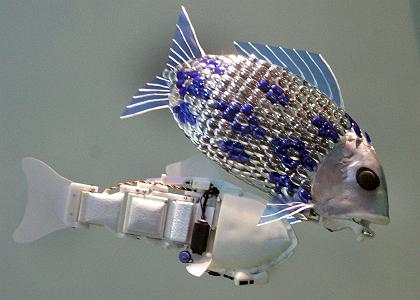
A number of robotic fish are going to be used in an experiment in the port of Gijon in Spain in order to evaluate how effectively and cost-efficiently they can detect water pollution. The 1.5 meter carp-shaped robots are part of a three-year research project of Huosheng Hu and his robotics team at the School of Computer Science and Electronic Engineering, University of Essex. If the research proves itself, the robot fish could be used in rivers, lakes and seas across the world. The life-like creatures, which will mimic the undulating movement of real fish, will be equipped with tiny chemical sensors to find the source of potentially hazardous pollutants in the water, such as leaks from vessels in the port or underwater pipelines. When they recharge their batteries via a “charging hub” they will be able to transmit the information to the port’s control center. This will enable the authorities to map the source and scale of the pollution virtually in real time.
The robot fish have autonomous navigation capabilities, enabling them to swim independently around the port without any human interaction. This enables them to return automatically to their hub to be recharged when battery life (approximately eight hours) is low.
“I am incredibly excited about this project. We are designing these fish very carefully to ensure that they will be able to detect changes in environmental conditions in the port and pick up on early signs of pollution spreading, for example by locating a small leak in a vessel.”, Hu said, “The hope is that this will prevent potentially hazardous discharges at sea, as the leak would undoubtedly get worse over time if not located.”

 The robot fish have autonomous navigation capabilities, enabling them to swim independently around the port without any human interaction. This enables them to return automatically to their hub to be recharged when battery life (approximately eight hours) is low.“I am incredibly excited about this project. We are designing these fish very carefully to ensure that they will be able to detect changes in environmental conditions in the port and pick up on early signs of pollution spreading, for example by locating a small leak in a vessel.”, Hu said, “The hope is that this will prevent potentially hazardous discharges at sea, as the leak would undoubtedly get worse over time if not located.”